Separate enrichment from provenance
I allow taste-profile fields to refresh when better research arrives, while provenance fields fill only when empty so a model cannot overwrite known bottle facts.
Personal product system
I built the app after standing in front of the cellar with dinner underway, knowing I owned the right bottle and having no reliable way to find it.
Scans labels, tracks bottle provenance and physical rack position, estimates value, and recommends what to drink from the wines actually on hand.
The problem
The database knew I owned the bottle, yet the rack gave me no corresponding position, and the record mixed purchase facts with inferred attributes in ways that made both harder to trust.
I wanted label recognition, taste profiles, market values, and recommendations, but each generated judgment needed to remain visibly separate from provenance and other facts I already knew.
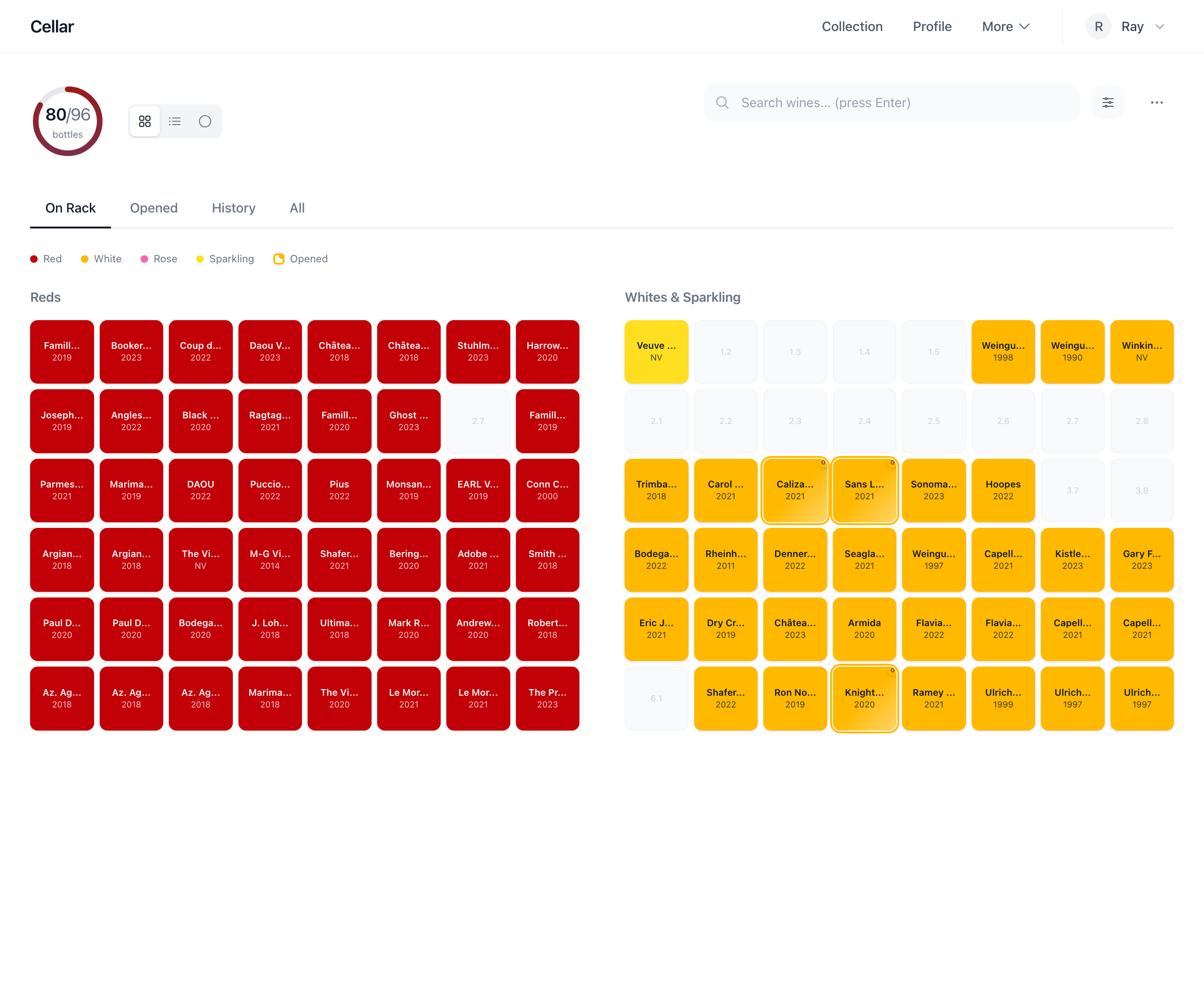
Production capture, 2026-08-30.
The approach
I mapped both cellar sections as a 6 by 8 grid and connected the physical position to collection records, label scanning, market-value estimates, taste modeling, grounded recommendations, an AI sommelier, and scheduled backups in one phone-friendly product.
The app runs on private infrastructure with configurable AI providers, field-specific data authority, and deterministic behavior available when a model path is unavailable.
The stakes are lower than missile defense. The discipline is the same.
Design decisions
I allow taste-profile fields to refresh when better research arrives, while provenance fields fill only when empty so a model cannot overwrite known bottle facts.
I made the digital rack mirror the real cellar, using drag and drop on desktop and a deliberate tap-to-move interaction on mobile.
I ground the sommelier and next-bottle ranking in wines I own, stated preferences, ratings, tasting notes, drinking windows, and clear dislikes.
I run schema initialization idempotently on every container start and keep scheduled compressed backups because a production drift incident made recoverability a design requirement.
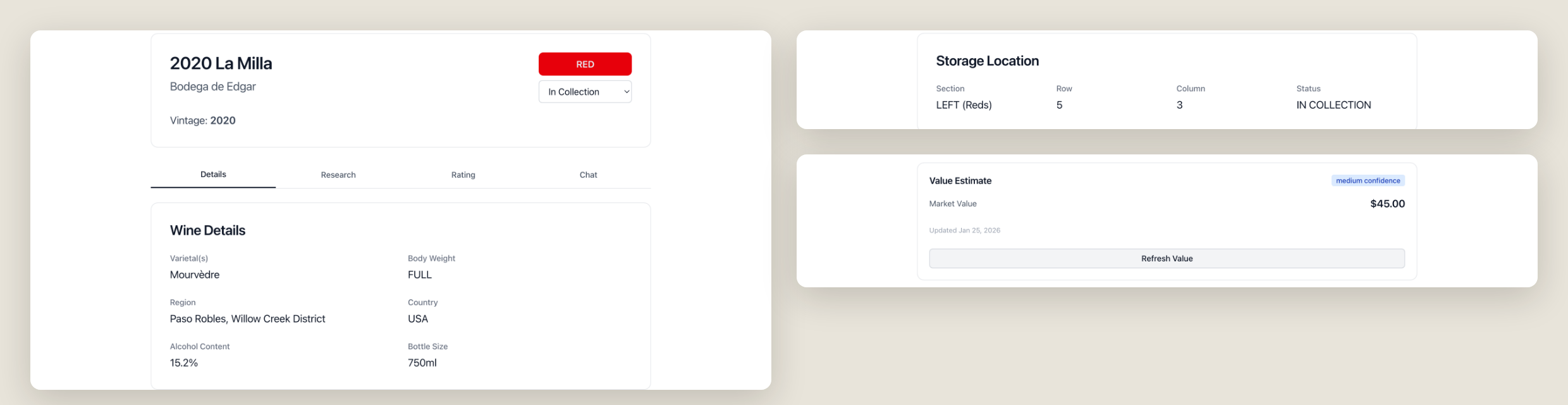
Production capture, 2026-08-30; panels arranged for the figure.
System configuration
What remains unproven
AI-generated market values are estimates, not appraisals, and recommendation quality is bounded by the collection history and tasting data available. The system preserves confidence and reasoning so those outputs can inform judgment without masquerading as source truth.